


- You are here:
- Home

- Business
Business Spotlight
For Love of Money by Marilyn Tam

Business
iPhones, Flipcams & Satellite modems are tools for news gathering as violence escalates against journalists in the Middle East
As violence is escalating against journalists working in war-torn countries, low profile or nearly invisible still and video cameras, and content capture and distribution technologies are becoming necessary survival gear.
The Committee to Protect Journalists has reported an unprecedented number of casualties: eleven journalists have been killed this year worldwide, eight of the eleven in the Middle East, one in Vietnam, one in the Philippines, and one in Mexico. CPF reports that there have been more than 300 attacks on journalists covering the recent political unrest in the Middle East.
CNN's
Anderson
Cooper
and
his
camera
crew
were
attacked
by
pro-government
supporters
on
February
2,
2011
in
Cairo
while
covering
the
Egyptian
conflict.
A
video
shot
by
Cooper
for
CNN's
AC360
can
be
seen
on
this
link.
Cooper
was
able
to
keep
his
small
Flip
video
camera
recording,
as
he
was
escaping
from
his
attackers.
While
Cooper
was
able
to
broadcast
his
reports
and
fly
back
to
New
York,
many
other
journalists
have
not
been
as
lucky.
Some
have
been
jailed,
brutally
beaten,
stabbed
or
shot,
their
equipment
destroyed,
or
worse
-
killed.
The
large,
conspicuous
shoulder
mounted
video
cameras
have
quickly
been
replaced
by
low
profile
gear
such
as
the
miniature
Flip
video
cameras.
Laptops
are
being
replaced
in
the
field
by
iPhones
and
other
cell
phones
which
can
transmit
still
images,
audio
and
video,
and
update
blogs,
Twitter
and
Facebook
accounts.
Port Authority Police Officer David Lim Remembers - He was In the North Tower when it Collapsed
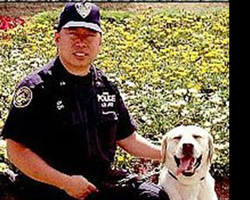
Port Authority police officer David Lim and his K-9 Sirius were inside the World Trade Center's North Tower when it collapsed on September 11, 2001.
He
shared
his
memories
recently
at
the
2011
conference
for
the
National
Asian
Peace
Officers
Association
in
San
Diego.
Click
here
for
the
full
story
and
a
video
interview
by
10News.
Click
here
-
CNN
Heroes
of
9/11
AMERICA
REMEMBERS
Port
Authority
Officer
David
Lim
and
K-9
Sirius.
Click
here
-
Sirius
is
among
dozens
of
Rescue
Dogs
honored
posthumously
by
the
American
Humane
Association.
Story
from
CBS
New
York.
California Governor Signs Bill Requiring Accurate Collection of Information on AAPIs
LOS ANGELES –
APALC News Release:
October 10, 2011
Bill co-sponsored by APALC requires the disaggregation of data on Asian ethnic groups in key state departments.
Legislation requiring key state agencies to collect and post information about job programs participation and employment and housing discrimination faced by Asian and Pacific Islander ethnicities was signed by Governor Jerry Brown on Sunday.
Assembly
Bill
(AB)
1088,
introduced
by
Assemblymember
Mike
Eng
(D-Monterey
Park)
and
co-sponsored
by
the
Asian
Pacific
American
Legal
Center
(APALC),
a
member
of
Asian
American
Center
for
Advancing
Justice;
Asian
Americans
for
Civil
Rights
and
Equality
(AACRE);
and
Asian
and
Pacific
Islanders
California
Action
Network
(APIsCAN),
requires
two
key
state
agencies
to
include
the
full
spectrum
of
Asian
American
(AA),
as
well
as
Native
Hawaiian
and
Other
Pacific
Islander
(NHOPI)
ethnicities
in
their
data
collection,
consistent
with
those
groups
reported
by
the
U.S.
Census.
Filipino WWII Veterans Celebrate California Governor Signing of CA Assembly Bill 199 recognizing their contributions.
News
Release
October
13,
2011
Assemblywoman
Fiona
Ma
California
Speaker
Pro
Tempore
12th
Assembly
District
California Assembly Bill 199 will help ensure that the contributions of Filipino veterans who fought side by side American troops are properly recognized and remembered by future generations.
Assemblywoman
Fiona
Ma
(D-San
Francisco
and
San
Mateo
Counties),
announces
the
signing
of
Assembly
Bill
199
this
Friday
October
14,
2011
at
Bessie
Carmichael
Middle
School
in
San
Francisco.
Bessie
Carmichael,
whose
school
population
is
50%
Filipino,
sits
in
the
SOMA
district
of
San
Francisco,
home
to
many
Filipino
WWII
Veterans.
When
this
bill
was
originally
introduced
in
2004,
98
Filipino
WWII
veterans
were
still
alive
to
tell
their
stories.
Today,
there
are
only
17
veterans
still
alive.
Two
previous
versions
of
this
bill
were
vetoed
by
Governor
Schwarzenegger.
AB
199,
the
Filipinos
in
WWII
Social
Studies
Curriculum
Act,
is
the
first
step
toward
ensuring
that
social
science
instruction
in
grades
7-12
includes
the
significant
role
of
Filipinos
in
World
War
II.
This
bill
helps
ensure
that
our
children
and
future
generations
learn
of
the
contributions
and
sacrifice
of
these
brave
Filipino
soldiers
before
we
lose
them
in
history.
During
World
War
II,
the
Philippines
was
a
commonwealth
of
the
United
States.
Filipino
soldiers
in
the
US
Armed
Forces
were
in
effect
US
nationals,
who
fought
side
by
side
with
American
Troops.